By Kenneth Richard on 25. January 2024
“There can be no climate equilibrium state that can be perturbed by an increase in the atmospheric concentration of CO2…” – Clark, 2023 The anthropogenic global warming paradigm has a magnitude problem – especially when it comes to the assumption that we humans can warm the ocean with our CO2 emissions. New research suggests the […]
Posted in Climate Sensitivity, CO2 and GHG |
By Kenneth Richard on 22. January 2024
Doubling the 2005 CO2 concentration (380 ppm) to 760 ppm only produces a globally-averaged 2.26 W/m² perturbation at the top of the atmosphere (TOA). This doubled-CO2 forcing is close to 0 W/m² for large portions of the globe – including below 0 W/m² for Antarctica. The IPCC claims doubling CO2 produces a 3.7 W/m² TOA […]
Posted in Climate Sensitivity, CO2 and GHG |
By Kenneth Richard on 18. January 2024
We have updated our “Extremely Low CO2 Climate Sensitivity” scientific paper list with new papers added from 2022 and 2023 and some newly discovered papers from the past. As of 2016 this list had only 50 papers on it (as indicated by the web address). In less than 8 years the list has grown to […]
Posted in Climate Sensitivity, CO2 and GHG |
By Kenneth Richard on 15. January 2024
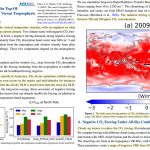
“Negative TOA [top of atmosphere] forcing of CO2 increase also happens outside of Antarctica. The Arctic sometimes exhibits strong negative CO2 forcing. This phenomenon even occurs in the tropics and mid-latitudes…” – Chen et al., 2024 It has previously been reported that as CO2 increases from 380 ppm to 1000 ppm, the CO2 greenhouse effect […]
Posted in Antarctic, Arctic, Climate Sensitivity, CO2 and GHG |
By Kenneth Richard on 11. January 2024
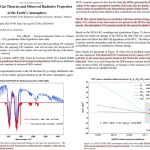
“The real atmosphere does not follow the GHG [greenhouse gas] GE [greenhouse effect] hypothesis of the IPCC.” – Miskolczi, 2023 CO2 increased from 310 ppm to 385 ppm (24%) during the 60 years from 1948 to 2008. Observations indicate this led to a negative radiative imbalance of -0.75 W/m². In other words, increasing CO2 delivered […]
Posted in Climate Sensitivity, CO2 and GHG |
By Kenneth Richard on 8. January 2024
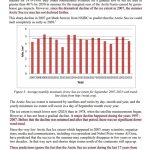
“[S]ince the dramatical decline of the ice extent in 2007, the summer Arctic sea ice area has not declined further.” – Astrup Jensen, 2023 Scientists have been using the year 2007 as the starting point for assessing Arctic sea ice trends for nearly a decade. A 2015 study published in Nature Climate Change reported a “near-zero […]
Posted in Arctic, Sea Ice |
By Kenneth Richard on 4. January 2024
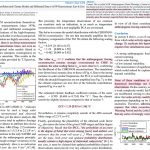
AGW proponents use subjective forcing models and unmeasured estimates of past solar activity to claim humans drive warming. A scientist’s (Larminat, 2023) reassessment finds the Sun can drive climate, equilibrium climate sensitivity (ECS, 2xCO2 + feedbacks) is 1.14°C, and human forcing is overestimated. Because there have been no direct measurements of solar activity until the […]
Posted in Climate Sensitivity, Solar Sciences |
By Kenneth Richard on 1. January 2024
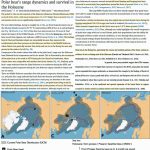
Arctic regions with 6+ months of sea ice coverage today were ice-free nearly year-round 9,000 to 5,000 years ago (2°C warmer) and 130,000 to 115,000 years ago (7-8°C warmer). And yet polar bears survived these periods. Per a new study, today’s Scandinavian Arctic climate is so cold it is actually “comparable” to that of the […]
Posted in Arctic, Paleo-climatology, Sea Ice |
By Kenneth Richard on 28. December 2023
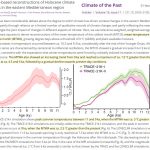
According to a new study, eastern Mediterranean summer temperatures were 1.5°C to 3°C “greater than the present” from about 11,000 to 7,000 years ago, when CO2 levels were approximately 265 ppm. Then the temperatures “followed a gradual decline towards present-day conditions”. “The MTWA also showed an increasing trend from 9 ka and reached a maximum of […]
Posted in Paleo-climatology
By Kenneth Richard on 21. December 2023
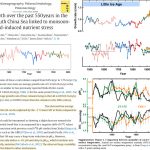
Warmer sea surface temperatures are associated with coral growth, not decline. According to a new study, coral growth was slow during the ~1°C colder Little Ice Age (LIA), but grew rapidly as sea surface temperatures (SSTs) warmed after 1850. Warmth is associated with coral growth, whereas colder SSTs are linked to growth rate decline. “The […]
Posted in Coral Reefs, Little Ice Age, Paleo-climatology |
By Kenneth Richard on 18. December 2023
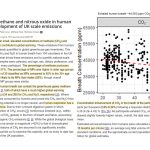
“Where hydrocarbon chains (food types) are consumed by humans and turned into CH4 [methane] … global warming potential is no longer neutral, and human respiration has a net warming effect on the atmosphere.” – Prada et al., 2023 Image Source pexels.com (stock photo) According to a new study, humans “contribute to global warming” by exhaling […]
Posted in CO2 and GHG, Emissions, We're To Blame |
By Kenneth Richard on 14. December 2023
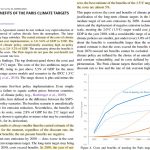
The benefits of not meeting Paris Accord emissions-reduction targets outweigh the costs associated even with worst-case-scenario global warming throughout the 21st century. A new comprehensive analysis (Tol, 2023) weighs the cost-benefit of meeting Paris Accord emission policy targets to keep global warming in check, or under 2°C. The analysis reveals that even in the best […]
Posted in Climate Politics, Green Follies |






Recent Comments