By Kenneth Richard on 18. July 2024
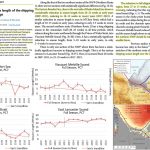
Global warming was supposed to open up Arctic region shipping routes, making the Northwest Passage easier and less risky to traverse. Per a new study, the opposite has happened. As we reported earlier this year, while a declining trend in Arctic sea ice was observed from the 1990s to 2007, there has been no trend […]
Posted in Arctic, Sea Ice |
By Kenneth Richard on 16. May 2024
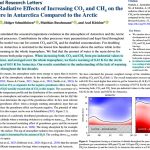
The phenomenon of increasing the concentration of greenhouse gases (water vapor, carbon dioxide, methane) is assumed to lead to sharply rising temperatures in polar regions, or “polar amplification.” As it turns out, it doesn’t. Per a new radiative forcing model (Notholt et al., 2024), increasing CO2 from pre-industrial to present levels (278 to 400 ppm) […]
Posted in Antarctic, Arctic, Climate Sensitivity |
By Kenneth Richard on 9. May 2024
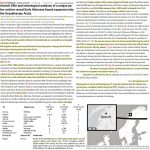
A new study finds warmth-demanding species could survive in the Holocene Arctic (northern Norway) hundreds to thousands of km north of where they reside today. This affirms temperatures were “higher than today” with much less snow and ice back then. DNA evidence from a site north of the Arctic Circle indicates African wildcat (Felis lybica) […]
Posted in Arctic, Paleo-climatology |
By P Gosselin on 27. April 2024
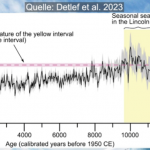
Early Holocene was warmer 10,000 years ago…Arctic ice melted. The European Institute for Climate and Energy (EIKE presents its latest climate video at its Youtube channel. Examined today is a paper appearing in the journal Nature Communications titled: “Seasonal sea-ice in the Arctic’s last ice area during the Early Holocene” The authors looked at sea […]
Posted in Arctic |
By P Gosselin on 14. April 2024
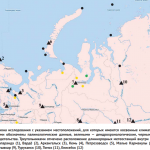
Dr. Michael E. Mann and the IPCC claims of a hockey stick temperature trend are challenged. A paper published by a team of scientists of the Russian Academy of Sciences led by В. V. Klimenko presents a quantitative reconstruction of the mean annual temperatures of northeastern Europe for the last two millennia. The study was […]
Posted in Arctic, Paleo-climatology |
By P Gosselin on 27. March 2024
Winter sea ice in Arctic stable over past 20 years…has even recovered somewhat. Hat-tip: Klimanachrichten Arctic sea ice extent as recorded by Germany’s Alfred Wegener Institute (AWI) in Bremerhaven, Germany, looks at the situation in January 2024. Despite the record temperatures reported, the ice in the Arctic has recovered somewhat. The slight recovery trend since […]
Posted in Arctic |
By Kenneth Richard on 1. March 2024
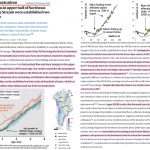
Ice flowed out of the interior of the Greenland ice sheet at much stronger rates and with much greater variability than today throughout the Holocene – or until about 2,000 years ago. New research (Jansen et al., 2024) has determined Greenland’s ice streams vary according to internal processes, and not necessarily due to external changes […]
Posted in Arctic, Glaciers, Paleo-climatology |
By Kenneth Richard on 15. January 2024
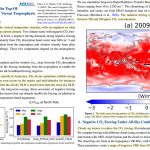
“Negative TOA [top of atmosphere] forcing of CO2 increase also happens outside of Antarctica. The Arctic sometimes exhibits strong negative CO2 forcing. This phenomenon even occurs in the tropics and mid-latitudes…” – Chen et al., 2024 It has previously been reported that as CO2 increases from 380 ppm to 1000 ppm, the CO2 greenhouse effect […]
Posted in Antarctic, Arctic, Climate Sensitivity, CO2 and GHG |
By P Gosselin on 14. January 2024
Some alarmist scientists claim it’s the hottest year on record, yet Arctic sea ice for this date stands at its highest level in 21 years. Hat-tip: EIKE here. Source: NSIDC This year’s reading – up to January 8 – has now far exceeded the average for the years 2011-2010, also exceeds the average for the […]
Posted in Arctic |
By Kenneth Richard on 8. January 2024
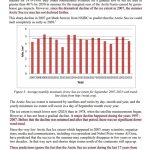
“[S]ince the dramatical decline of the ice extent in 2007, the summer Arctic sea ice area has not declined further.” – Astrup Jensen, 2023 Scientists have been using the year 2007 as the starting point for assessing Arctic sea ice trends for nearly a decade. A 2015 study published in Nature Climate Change reported a “near-zero […]
Posted in Arctic, Sea Ice |
By Kenneth Richard on 1. January 2024
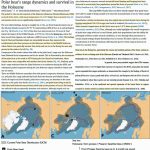
Arctic regions with 6+ months of sea ice coverage today were ice-free nearly year-round 9,000 to 5,000 years ago (2°C warmer) and 130,000 to 115,000 years ago (7-8°C warmer). And yet polar bears survived these periods. Per a new study, today’s Scandinavian Arctic climate is so cold it is actually “comparable” to that of the […]
Posted in Arctic, Paleo-climatology, Sea Ice |
By P Gosselin on 6. December 2023
A top polar scientist interviewed by the Russian Academy of Sciences says we need to prepare for serious global cooling, to begin by 2030-2035. Cites studies of Lake Baikal and historic climate epochs. Andrey Fedotov. Photo: Siberian Branch of the Russian Academy of Sciences. People’s Voice here reports: “One of the world’s top Arctic scientist’s […]
Posted in Arctic, Cooling/Temperature, Russian Climate Science |


Recent Comments