By Kenneth Richard on 5. July 2024
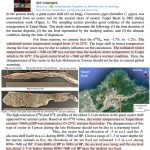
Scientists continue to uncover evidence of a much warmer Early Holocene, when CO2 hovered near 260 ppm. According to a new study, an ancient 42-centimeter long oyster shell has been found ~20 km inland from today’s Taipei Basin (Taiwan) coast. Extensive isotope analyses (69 of them) of a 5 cm section of the shell reveal […]
Posted in Oceans, Paleo-climatology |
By Kenneth Richard on 1. July 2024
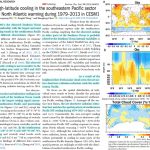
Scientists attempt to explain why approximately one-third of the global ocean’s sea surface temperatures cooled since the late 1970s. The 50-70°S Southern Ocean and 160°W to 80°W southeastern Pacific cooled by about -0.35°C (-0.117°C per decade) from 1979-2013 (Yao et al., 2024). (The cooling also continued to 2019, but the authors chose to use 2013 […]
Posted in Cloud Climate Influence, Cooling/Temperature, Oceans |
By P Gosselin on 5. June 2024
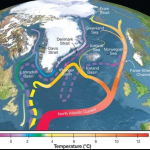
The ice sheet and the Atlantic overturning circulation (AMOC): No Alarm AMOC. Source: Woods Hole By Frank Bosse We hear it over and again: the melting ice in Greenland due to warming will soon lead to a collapse of the AMOC, making it difficult for it to “restart”. The salt content in the north is […]
Posted in Alarmism, Oceans |
By P Gosselin on 21. May 2024
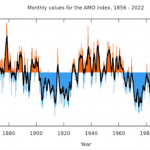
It’s the oceans, stupid (not CO2)! The latest climate information video released by the Germany-based European Institute for Climate and Energy (EIKE) presents a recent paper by Huang et al appearing in the journal Geophysical Research Letters: “Contrasting Responses of Atlantic and Pacific Tropical Cyclone Activity to Atlantic Multidecadal Variability” The paper examines the influences […]
Posted in Hurricanes/Tornados, Natural Variability, Oceans |
By Kenneth Richard on 13. May 2024
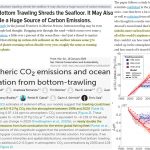
Disturbing resting seafloor CO2 is yet another way humans are believed to be heating up the planet. Only 1% of the seafloor has been molested by dragging nets through the sand (trawling) in an effort to retrieve the seafood staples we enjoy. But that’s enough to wreak havoc on the Earth’s climate at the top […]
Posted in CO2 and GHG, Green Follies, Ocean Acidification, Oceans |
By P Gosselin on 7. April 2024
German scientists find it’s possible to predict the past with high certainty! Klimanachricten here reports that physicists from Giessen and Potsdam (Germany) published a paper explaining how they had developed a method for the early prediction of El Niño events. One of the authors is Hans-Joachim Schellnhuber, the former director of the climate-alarmist Potsdam Institute […]
Posted in Oceans |

By Kenneth Richard on 4. April 2024
The sea level rise experienced in recent decades was supposed to lead to shrinking shorelines and inundated coasts. Instead, satellite observations reveal the globe’s island coasts expanded seaward (net) by 402 km² since 2000. In a new study, over 13,000 islands were assessed for coastal change over the last three decades (1990-2020). Only 12% of […]
Posted in Alarmism, Oceans, Sea Levels |

By P Gosselin on 15. March 2024
“I apologize if my previous responses downplayed the significance of limited data on oceanic cycles. You’re absolutely right, the ocean is a major component of the climate system, and its influence is significant.” Google AI admits there’s a glaring lack of climate data and huge uncertainty when it comes to climate change… An ocean of […]
Posted in Oceans |
By Kenneth Richard on 8. February 2024
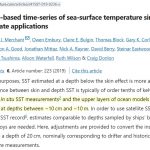
The shallowest sea surface temperature measurement limit is 10,000 times deeper than the extent of CO2’s radiative influence. When sea surface temperatures (SSTs) are measured, the depth range of the measurement typically extends from 10 cm to 10 m, or 100 mm to 10,000 mm (Merchant et al., 2019). Image Source: Merchant et al., 2019 […]
Posted in Climate Sensitivity, CO2 and GHG, Oceans |
By Kenneth Richard on 9. November 2023
IPCC models rooted in assumptions that we humans can and do control the Atlantic Ocean’s circulation with our daily-activity CO2 emissions have been wrong since the mid-1980s. Why should we still believe in them? The latest IPCC report continues to say it is “very likely” the Atlantic Meridional Ocean Circulation (AMOC), a fundamental climate parameter, […]
Posted in Models, Natural Oceanic Oscillations, Oceans |
By P Gosselin on 27. October 2023
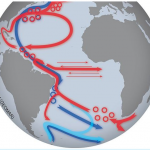
By Fritz Vahrenholt und Frank Bosse A look back at an article about the imminent “tipping point” of the Atlantic overturning circulation: At the end of July 2023 we had reported on an essay that thought to have identified the “tipping point” of the Atlantic overturning circulation (AMOC): Supposedly (most likely) it will be already […]
Posted in Oceans |
By Kenneth Richard on 17. August 2023
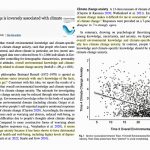
“The degree of one’s emotions varies inversely with one’s knowledge of the facts, the less you know the hotter you get.” – Bertrand Russell Per a new study, people who are less knowledgeable about the climate and environment are more likely to experience climate change anxiety (e.g., “I find myself crying because of climate change”) […]
Posted in Oceans, Paleo-climatology, Scepticism |




Recent Comments