By Kenneth Richard on 18. March 2024
“From modern instrumental carbon isotopic data of the last 40 years, no signs of human (fossil fuel) CO2 emissions can be discerned.” – Koutsoyiannis, 2024 It is routinely claimed that a telltale sign human emissions (fossil fuels) have irrevocably altered the atmospheric CO2 concentration is a declining trend in carbon isotope 13 (δ13C), considered an […]
Posted in CO2 and GHG, Emissions |
By Kenneth Richard on 18. December 2023
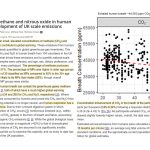
“Where hydrocarbon chains (food types) are consumed by humans and turned into CH4 [methane] … global warming potential is no longer neutral, and human respiration has a net warming effect on the atmosphere.” – Prada et al., 2023 Image Source pexels.com (stock photo) According to a new study, humans “contribute to global warming” by exhaling […]
Posted in CO2 and GHG, Emissions, We're To Blame |

By Kenneth Richard on 12. October 2023
For decades rock weathering has been thought to be a net sink in carbon budget models. New research finds rock emissions are a large net source of CO2 to the atmosphere. A few years ago Buesseler et al., 2020 discovered that all of the climate modelers’ previous estimates of global ocean carbon uptake are substantially […]
Posted in Emissions, Models |
By Kenneth Richard on 18. September 2023
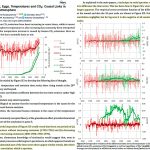
“Oddly, while the principal direction suggested by the models is ΔIn[CO₂] → ΔT, the explained variance is impressively low (10-15%) in this direction and impressively high (reaching 90%) in the opposite direction, at ΔT → ΔIn[CO₂].” − Koutsoyiannis et al., 2023 One of the most basic concepts in physics is that causes precede effects and effects […]
Posted in CO2 and GHG, Emissions |

By Kenneth Richard on 10. November 2022
An increase in effective radiative forcing from human activity is now said to be mostly driven by a decline in aerosol pollution, superseding the effects of CO2 emissions. The majority of an alleged acceleration in anthropogenic global warming in the 21st century “is driven by changes in the the aerosol [effective radiative forcing] trend, due […]
Posted in Emissions |
By Kenneth Richard on 4. August 2022
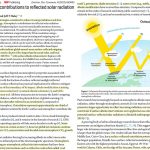
Adding reflectors to roofs and pavements and similar strategies could globally reflect 87 W/m² more incoming solar radiation than is reflected on an annual basis currently, cooling the surface. In contrast, the sum of the accumulated annual anthropogenic radiative forcing from greenhouse gases (GHG) since 1750 is 2.72 W/m². A new study analyzes the effectiveness […]
Posted in Emissions, Solar Sciences |

By Kenneth Richard on 2. June 2022
Instead of focusing on probabilistic percentages and constructed correlations between two events in efforts to determine potential causality, 4 scientists have revisited the requisite conditions for causality in applying the scientific method. They find “the common perception that increasing CO2 causes increased [temperature] can be excluded because it violates the necessary condition for this causal […]
Posted in CO2 and GHG, Emissions |
By Kenneth Richard on 23. May 2022
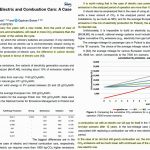
A new study finds “the total CO2 emissions will be much lower with continued use of the old but operational combustion car instead of buying a new electric one.” Image Source: Neugebauer et al., 2022 It has long been assumed that replacing internal combustion engine (ICE) vehicles with electric vehicles (EV) will lead to dramatically […]
Posted in Alternative Energy, Emissions, Green Follies |
By Kenneth Richard on 16. May 2022
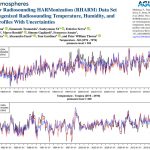
A new study indicates nearly all the Northern Hemisphere and Tropical warming in the last 40 years occurred by the late 1990s. CO2 has risen by about 50 ppm since 1998 (367 to 418 ppm). Interestingly, upper-air measurements of temperature from balloon-borne sensor radiosonde data, shown below in the image from a new study (Madonna […]
Posted in CO2 and GHG, Emissions, Oceans |

By Kenneth Richard on 2. May 2022
“Burning woody biomass increases atmospheric CO2 levels for decades. Burning forest biomass for power generation emits more CO2 per-unit of final energy than burning fossil fuels, including coal.” – Bloomer et al., 2022 Image Source: IGSD It is scientifically well known that (a) “the carbon emission from wood fuel is bigger by half than that […]
Posted in Alternative Energy, Emissions, Green Follies |
By Kenneth Richard on 15. July 2021
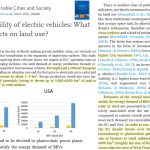
A new study warns that “a massive expansion of impervious surfaces” is an inevitable consequence of having electric vehicles reach a 40% share of citizens’ driving needs. A land area the size of Croatia (in the European Union) or West Virginia (in the United States) must be completely covered with wind turbines to meet EV-charging […]
Posted in Emissions, Green Follies, Wind Power |

By Kenneth Richard on 27. May 2021
There has been a sustained global-scale effort to reduce coal power capacity in recent years. Meanwhile, China’s government has been busy loosening restrictions on coal plant construction to power its post-pandemic economy. In 2020, China built over three times as much new coal power capacity as all other countries in the world combined – with […]
Posted in Climate Politics, Emissions |





Recent Comments