
By Kenneth Richard on 7. September 2023
More and more evidence is emerging that the modern warming trends are naturally driven, not anthropogenic. Per CERES observations the surface incident shortwave (SW) radiation anomaly increased by +1.61 W/m² from 2001 to 2019, and +1.75 W/m² from 2001 to 2021 (Ollila, 2023). This SW increase is likely due to natural variations in cloud cover […]
Posted in Cloud Climate Influence, Natural Variability, Solar Sciences

By Kenneth Richard on 4. September 2023
Nearly all of the alleged anthropogenic link to climate change can be removed simply by exchanging and/or replacing biased temperature and solar activity data sets. A new study authored by 37 scientists in the journal Climate finds using rural-only Northern Hemisphere temperature data (i.e., removing artificial, non-climatic urban heat effects) reduces the post-1850 warming trend […]
Posted in Natural Variability, Solar Sciences, Temperature Bias/Urbanization |

By Kenneth Richard on 24. April 2023
A new study exposes the uncertainty in solar activity reconstructions, but suggests solar models explain climate changes far better than atmospheric CO2 concentrations. Proxy model estimates of the impact of solar variability on climate are highly uncertain. For example, estimations of the increase in solar irradiance over the last 400 years range anywhere from 0.75 […]
Posted in CO2 and GHG, Paleo-climatology, Solar Sciences |

By Kenneth Richard on 15. December 2022
Yet another observational study determines changes in Earth’s reflectiveness, or planetary albedo, may be primarily responsible for 21st century climate forcing. Earth’s radiation budget at the top of atmosphere (TOA) is predominantly controlled by internal changes in cloud cover. A declining albedo – linked to declining cloud cover – corresponds to an increase in the […]
Posted in Cloud Climate Influence, Solar Sciences |

By Kenneth Richard on 8. December 2022
Of the warming trends in Poland and greater Europe, “only about 4–5% are explained by an increase in CO2 concentration.” – Marsz et al., 2022 Internal changes to the thermal structure of the ocean transmit decadal-scale changes in the atmospheric circulation and consequent surface air temperature via its modulating impact on the variation in the […]
Posted in Climate Sensitivity, Cloud Climate Influence, CO2 and GHG, Solar Sciences |

By Kenneth Richard on 22. August 2022
Scientists have once again affirmed the 2000-2020 total greenhouse effect (longwave) forcing has been declining in recent decades just as absorbed solar radiation has been increasing due to cloud albedo modulation. The latter explains the net positive Earth Energy Imbalance (EEI) and consequent global warming during this period. Recently we detailed the satellite-observed decline in […]
Posted in Cloud Climate Influence, CO2 and GHG, Solar Sciences |
By Kenneth Richard on 4. August 2022
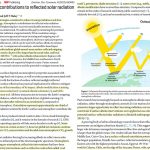
Adding reflectors to roofs and pavements and similar strategies could globally reflect 87 W/m² more incoming solar radiation than is reflected on an annual basis currently, cooling the surface. In contrast, the sum of the accumulated annual anthropogenic radiative forcing from greenhouse gases (GHG) since 1750 is 2.72 W/m². A new study analyzes the effectiveness […]
Posted in Emissions, Solar Sciences |

By Kenneth Richard on 23. June 2022
From about 11,000 to 9,000 years ago the summer solar irradiance absorbed by the Earth’s surface has been estimated to be 40-60 W/m² greater than today from latitudes 40°N to 70°N (Ullman et al., 2015). These values seriously undermine the claim CO2 is the driver of climate change. Image Source: Ullman et al., 2015 Despite […]
Posted in Climate Sensitivity, Solar Sciences |

By Kenneth Richard on 16. June 2022
There has been a “strong upward trend” in solar radiation over the European continent since the 1980s driven by natural ocean circulation factors responsible for “triggering and controlling the entire chain of events in climate processes.” A new study references Dr. Michael Mann’s claim that “changes in SST and heat resources in the waters of […]
Posted in Natural Oceanic Oscillations, Solar Sciences |

By Kenneth Richard on 14. March 2022
“The IPCC concept that increasing carbon dioxide in the atmosphere causes global warming is three decades out-of-date.” − Lightfoot and Ratzer (2022), Journal of Basic & Applied Sciences In analyzing UAH global temperature and Mauna Loa CO2 records from 1979 to 2021, climate researchers Lightfoot and Ratzer (2022) report there has been “little, if any” […]
Posted in Climate Sensitivity, CO2 and GHG, Cooling/Temperature, Solar Sciences |

By Kenneth Richard on 7. February 2022
Scientists: Due to the decline in solar geomagnetic activity the Earth is poised to endure a cooling period over the coming decades, with the coldest temperatures arriving by 2038 or 2039 ±11 years. Human greenhouse gas emissions are not likely the cause of recent temperature changes; geomagnetic activity is. Nor will greenhouse gases reverse the effects […]
Posted in CO2 and GHG, Cooling/Temperature, Solar Sciences |
By P Gosselin on 14. December 2021
A remarkable publication on solar influence on climate goes unnoticed By Prof. Fritz Vahrenholt (Die kalte Sonne) (Text translated/edited by P. Gosselin) On November 3, 2021, the renowned scientific journal Climate published a paper on solar influence on climate. The paper by the renowned solar researcher Dr. Frank Stefani from the Helmholtz Zentrum Dresden-Rossendorf is […]
Posted in Solar Sciences |





Recent Comments